By Sorena Atin and Lily Hodgson
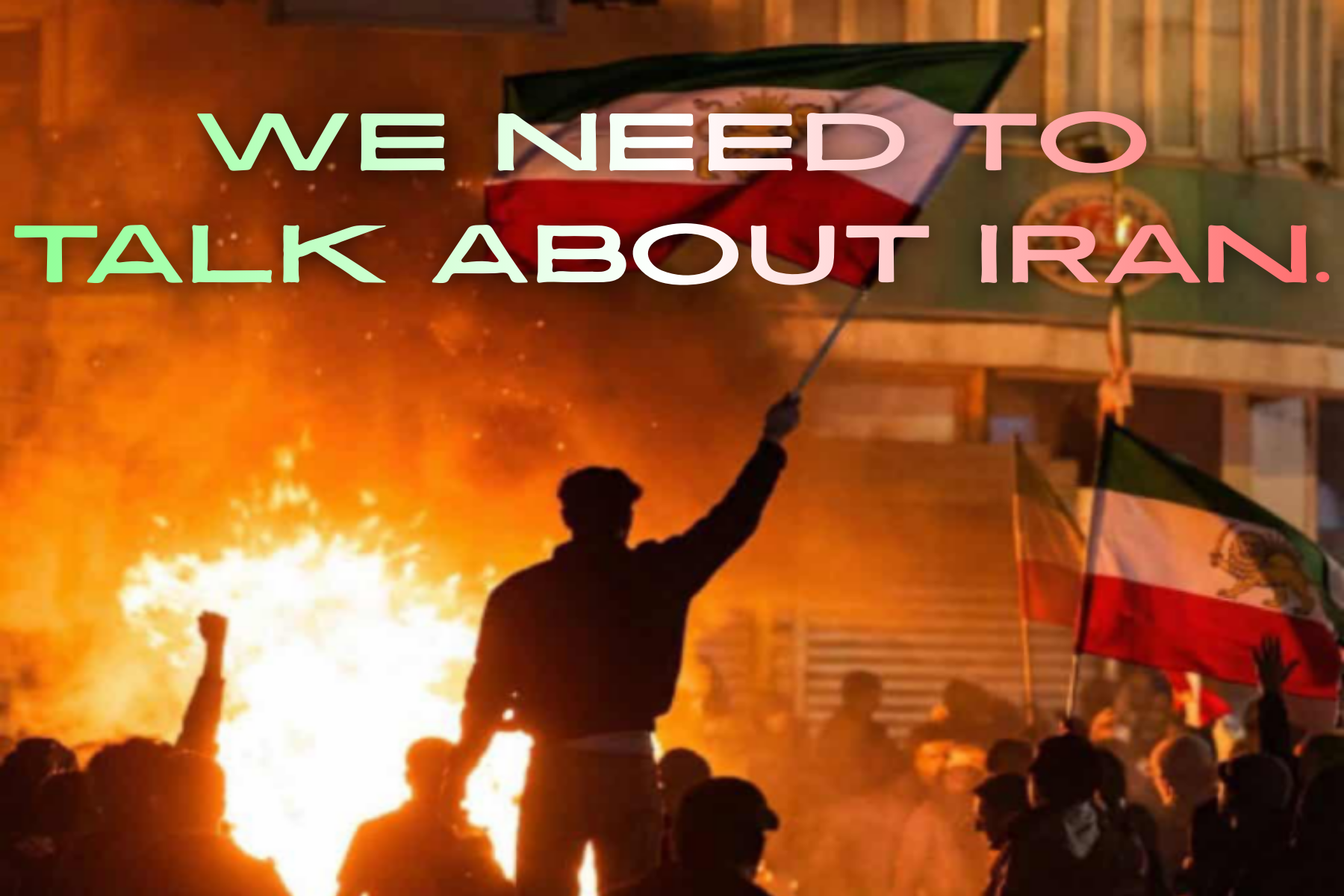
On January 8th and 9th, the Iranian government killed more than 36,500 people in two days. These people were out on the streets, originally protesting extreme inflation to the prices of essential goods across the country, but now calling for a change in the political regime. The protestors came from all walks of life – men, women, children, seniors, businessmen, lawyers, doctors, activists – and from all 31 provinces of Iran. The massacre was accompanied by a complete internet blackout which lasted nearly a month.
Sorena Atin, Brandon University’s only Persian student, is working hard to get people talking about the situation in Iran: “The world not talking about this is really sad and disappointing.” Between human rights organizations like the UN, and international laws like the Responsibility to Protect (R2P), Atin is frustrated that the world isn’t doing more. Even social media has been relatively quiet, on an issue that desperately needs international attention. As part of his mission to raise awareness, Atin has channeled his anger and despair into action. He’s been putting up posters all over campus, speaking in BU panels, talking to students and professors – and reaching out to The Quill to share his story.
36,500 dead is a low estimate. Countless bodies have gone unidentified, many being burned or maimed to the point of unrecognizability. The governmental security forces used military-grade bullets, makeshift weapons, chemical substances like modified tear gas, police vehicles – “anything that could silence the people,” Atin says.
Importantly, Atin urges that this is not an issue of politics or blame, but an issue of human rights. “No Iranian right now is wanting anything to do with politics, because it's their families, it's their nation, and it's the human lives that matters to them most. No oil-related thing, no politics-related thing. It's just their human lives. And if people claim that they care about human rights they should do research on topics like the situation in Iran… Iran is my focus, but at the same time, if human rights matter, it should matter for every single country around the world. It doesn't matter if one person died or 40,000 people died. It's human life. It matters.”
Following the two days of mass murder, the country’s medical system tried to recover. “People [were] overflowing all the hospitals and medical buildings. Which led to a shortage of supplies and medication,” Atin explains. “And at the same time the security forces started raiding hospitals to take all the injured people – take them away to put them in prison or kill them. A lot of doctors got arrested for trying to save people. A lot of nurses either got killed or injured in this process.” The Iranian government’s intentional targeting of injured persons in hospitals and medical centres is a clear violation of the most basic human rights.
The government’s treatment of the dead is also deeply disturbing. In a process that Atin refers to as “kidnapping” and “selling” dead bodies, the Iranian governmental forces began coming up with new ways to abuse grieving family members. They made families pay for each bullet in their deceased loved ones’ bodies, or offer sweets or thank-you letters to the police officers. In many cases, they forced people to sign legal documents stating that the dead individual was working for the government and was killed by protestors. This served the double purpose of lowering the reported number of protestor deaths, and providing an excuse for executing yet more protestors. And this is only when they agree to give the bodies back. It has been reported that the Iranian government is hiding bodies, to use as tools for propaganda – they’re using these corpses as “puppet[s]” to spread their false narrative.
Women and girls are especially at risk of abuse. The dead bodies of women and girls are frequently raped, and then the abusers force doctors to surgically remove the uterus and therefore the evidence.
While all this was going on, the internet shutdown prevented those outside the country from hearing a word about the safety of their loved ones. The complete blackout lasted for around twenty days, and was used to cover up the crimes against humanity that were being committed in Iran. Atin shares his own personal experience with the blackout: “I lost contact with all my family and friends… and it was terrifying. The Internet was already filtered or blocked essentially, on a regular basis. But now they cut off all communications, which means no Internet, no phone call forward line, nothing. We didn't have any news from our family or friends. Didn't know if they were OK, if they got arrested. Since there is no official news coverage in Iran, we didn't hear any news till a couple days after when it got a bit more calm … but not in a good way calm. There were too many dead bodies for the people to come out.”
Even now, internet access is not fully restored to the people of Iran. Only the country’s elites have full “whitelisted” access, which they use to spread propaganda online. For everyone else, calls and messages are heavily monitored. One wrong word, and the security forces can cut the line, show up at your home, and arrest you. Iranian citizens are forced to act like all is well to protect themselves. “Now they're starting to turn back on the Internet, so you get access and communication with friends and family, but just enough to keep both you and them anxious and not fully be honest with each other… because you can't be honest. You can't, because you don't know who's listening or who's monitoring you. So you always have to be extra, extra, extra cautious. People have to download VPNs to lose track of their Internet. Or they have to open secret chats that [when] you leave the chat, it just completely wipes the history.” Atin reveals his own experience communicating with loved ones for the first time after the blackout: “After we started finally calling, I finally heard my grandma's voice after seventeen days of completely no news or anything… Her voice was shaky, which was horrible to hear. And what made it worse was the fact that she was saying, ‘Oh yeah, everything's fine. We're all okay, nothing's wrong.’ That hurts. That hurts a lot to hear a family member talking like that, when you know it's not fine.”
The issues in Iran are far from over. People of all ages and all backgrounds are constantly being arrested, interrogated, and executed, often without cause – simply being in the wrong place at the wrong time is enough reason. Atin’s fifteen-year-old cousin was among those arrested, just for being out at a friend’s birthday party. Miraculously, she was released. He knows of many others who he grew up with, who were not so lucky.
These recent January protests were not the first example of the Iranian government striking down on activism, but it was certainly the deadliest. Over the past fifty years, since the 1979 Islamic Revolution, citizens have been demanding a change of government, demanding a better life. Atin remembers getting a censored education, only having access to manipulated and falsified history textbooks. He was present in Iran during the 2019 and 2022 protests, and the crimes he saw during those periods included the use of chemical gas in schools: “Because most of these protests were youth led, and … all these teenagers wanted a better life and more freedom, they wanted to silence them.”
The Iranian government’s crimes against humanity have gone unmentioned for far too long. Finally now, on an international scale, Atin is feeling some hope. “It made me really happy to hear the European Union, finally, after so many protests and letters to all these officials from Iranians to take action, their action was to put the IRGC [the Islamic Republic Guards Corp.] on the terrorist list. That is a huge shift which can impact the [government] a lot … [restricting] funding for its material use for ballistic missiles and everything.” There have also been several UN conferences discussing Iran, although no decisive action has been taken yet.
Additionally, there have been massive protests all over the world. “All the protests that [have] been organized with different people, groups of people coming out shouting Iran's name… You can see how respectful these protests are. There are videos of people [at] the protest who have garbage bags, and they're protesting as well as grabbing garbage from the ground. Or handing out flowers to whoever's not Iranian and supporting. Or all the police officers who are keeping everything in patrol, going and thanking them. And that's what we want the world to see, because the Iranian government, the Iranian regime, does not define us Persians, us as the Iranian community. We want the world to see us as also normal human beings, someone with culture, someone with prosperity. Someone who just wants a normal life like any other country in the world… democracy, freedom… basic rights.”
So what can we do, as individual students here at Brandon University? It’s hard, when faced with such a huge issue, not to give up hope. But there is hope for the future of the Iranian people. The keys to this hope are education, awareness, and advocacy. We all need to do research, learn about the history of Iran, speak up on social media, organize and participate in protests, write to our political officials. The Iranian government’s goal is to silence protestors – we can not allow them to silence us too.
When asked if he had any closing remarks for The Quill’s readers, Atin emphasized his gratitude: “I just wanted to thank Brandon as a community and Brandon University because of all the support that I've been getting throughout these couple of weeks. Personally, I've been going through a rough time trying to cope with this, because it's essentially like a war happening. I just wanted to thank all the staff members, all the people in this school, and anyone up to now that has been talking about Iran. It means the world to me, and they have my eternal gratitude for all of us.”
